
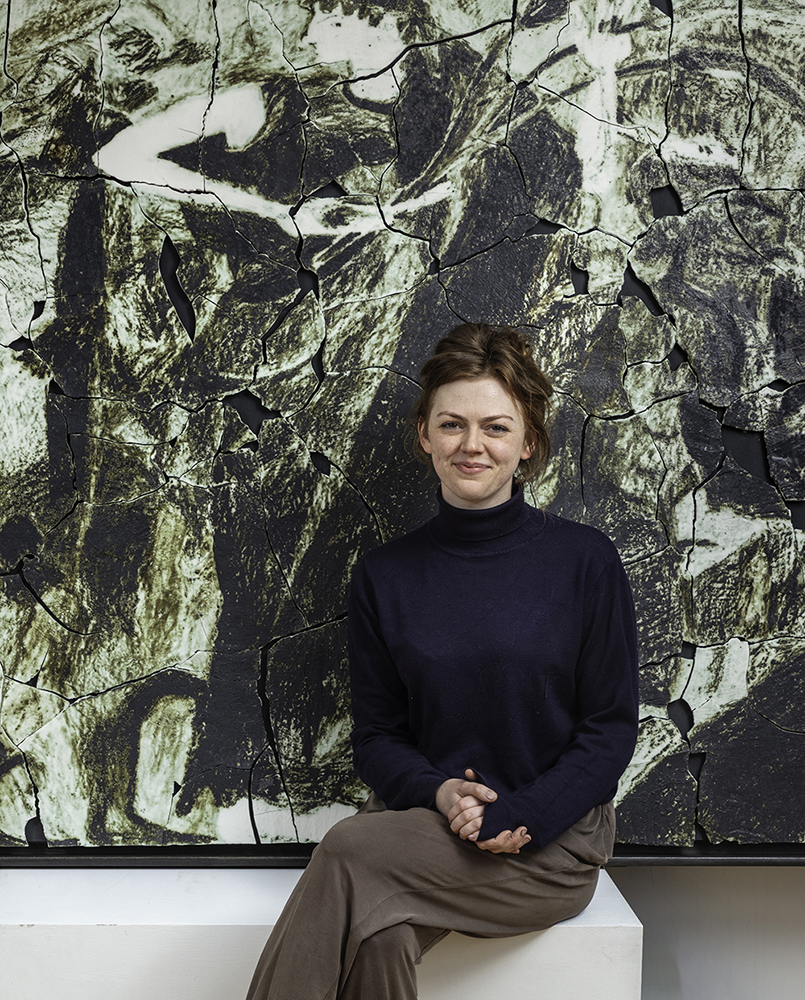
Congratulations on your new solo exhibition, Lessons in Spring. Can you tell us about the title and where it came from?
I went round and around before arriving at the title. I’ve been teaching a classical tutor for years, who has been invaluable in helping me understand the myths more deeply. These myths were part of how the ancient Greeks understood the world around them, and this was genuinely their origin story for the changing of the seasons. At that point the title clicked, Lessons in Spring.
But it also goes further than that. The myth sits at the core of the Eleusinian Mysteries, which stem from the Homeric Hymn to Demeter. These rites remain one of the most elusive aspects of the ancient world, but what we do know is that they were concerned with helping people live with mortality, inspired by Persephone’s cyclical absence.
I wanted the title to hold that weight. It positions the work not just as a retelling, but as something closer to a lesson, or perhaps even a question. Yes, this is how spring was understood to come about, but also, what might we learn from the changing of the seasons?
The Homeric Hymn to Demeter explores themes of loss, renewal, and seasonal rhythms amongst other things. What first drew you to this myth in particular, and why did it feel resonant at this moment in your practice?
I think with Greek myths in general, what I love is that, unlike fables, there isn’t really a clear lesson to take from them. That lack of resolution gives these immortal figures something much more human.
It might be the mother–daughter relationship, the seasonality or the rawness of a mother’s grief, but this myth has always chimed deeply with me. What really set me on this path was trying to understand the Eleusinian Mysteries and how they helped people think about life and death. What completely stopped me was realising that, of all the surviving artefacts, there is only one known object that depicts the rites: the Ninnion Tablet. That absence feels eerie, as though something deliberately withheld. In that moment, the thousands of years seem to melt away and I don’t feel so different from the people who came before us.
_Copper%20oxide%20on%20Parian%20porcelain.jpg?width=1500&height=921&name=4%20Zoe%20Andrews_Search%20(lanterns)_Copper%20oxide%20on%20Parian%20porcelain.jpg)
The exhibition is primarily showing drawing and ceramics. How do these two mediums work in dialogue in your practice?
For me, it’s always about working with the constraints of a material and what it can offer. I’ve been drawn to working across disciplines, where there is a constant question - and better yet friction - of what ceramics can offer drawing and what drawing can offer ceramics.
It began quite literally with paper. I was shredding and burning drawings, and through that arrived at charcoal and ash. Charcoal is carbon, but once fired it leaves behind a mineral residue - ash. Not only a pigment, ash is a powerful flux, a core ingredient in glazes that helps to melt the surface. Together with copper, a metal that introduces the range of greens you see throughout the show, this established a shared material language.
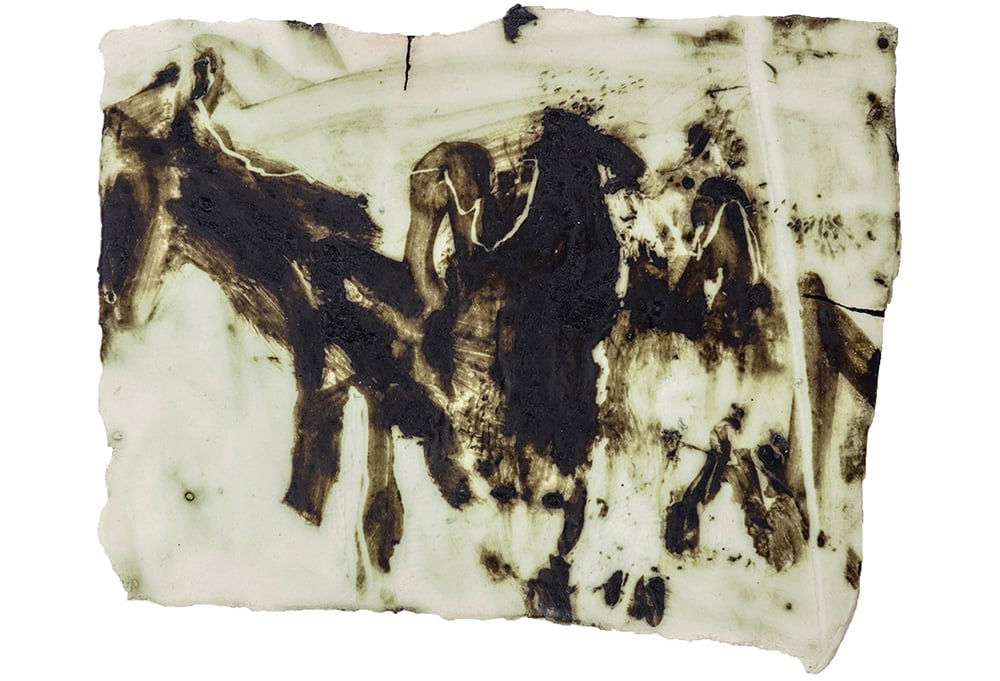
Ceramics taught my drawings to accept transformation, to allow things to change through process and heat. Porcelain also revealed the value of light, leading me towards translucent papers. Drawing, in turn, taught my ceramics how to hold a mark. Working on bone-dry porcelain, copper oxide brushes like ink and moves like charcoal. It’s very tactile, and almost indistinguishable from traditional drawing, much like using copper wax bars which apply like any other crayon.
Whilst drawing might be associated with a controllable medium, ceramics seems to embrace uncertainty and the unknown. You never know what might come out of the kiln. Can you tell us about the role of chance and spontaneity in your work? What is it like to surrender to the process with trust? And what is your approach when things 'go wrong’?
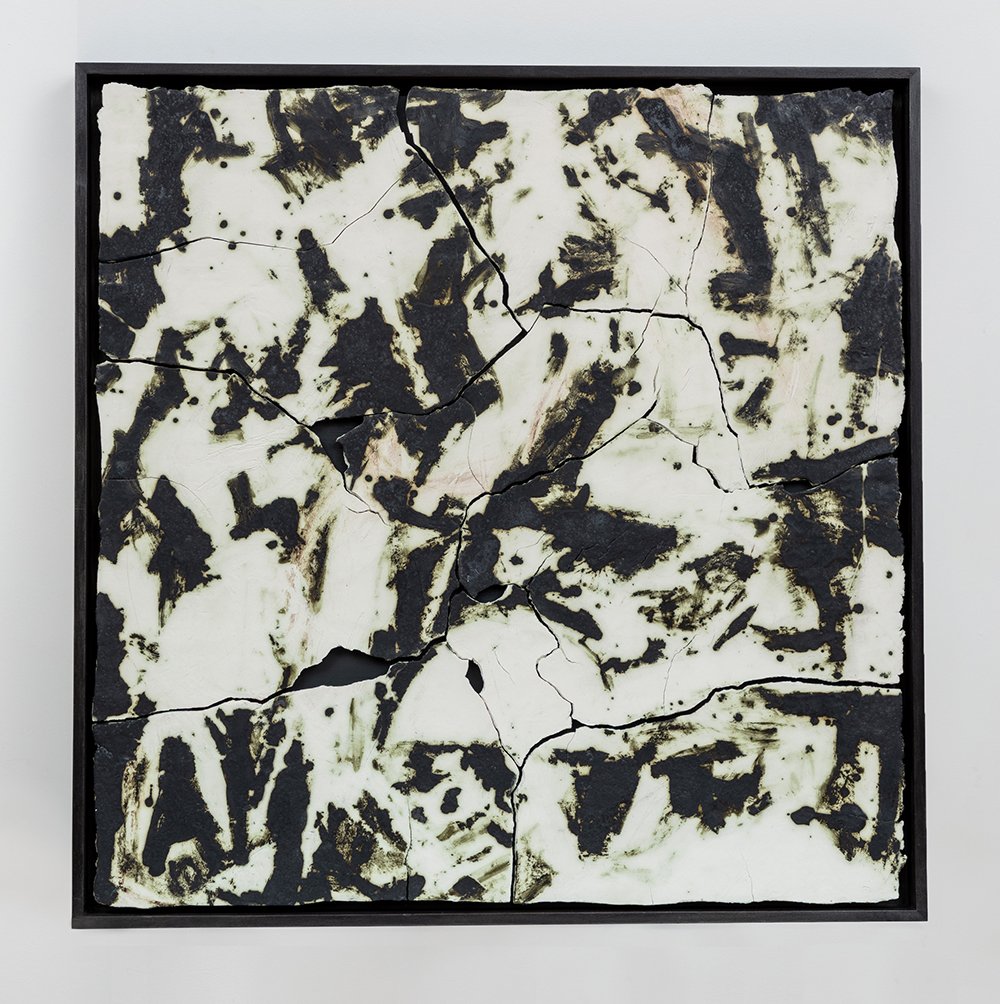
I’ve learnt to embrace when things go wrong, and things go wrong a lot. You learn to laugh and to ask if there is something in it. In ceramics, the hurdles you have to cross just to reach the kiln are enough. For one set of tiles, the kiln radically overfired to around 1270°C. The copper melted, the entire kiln load was destroyed and it wiped out all my kiln shelves. Moments like that are just gutting.
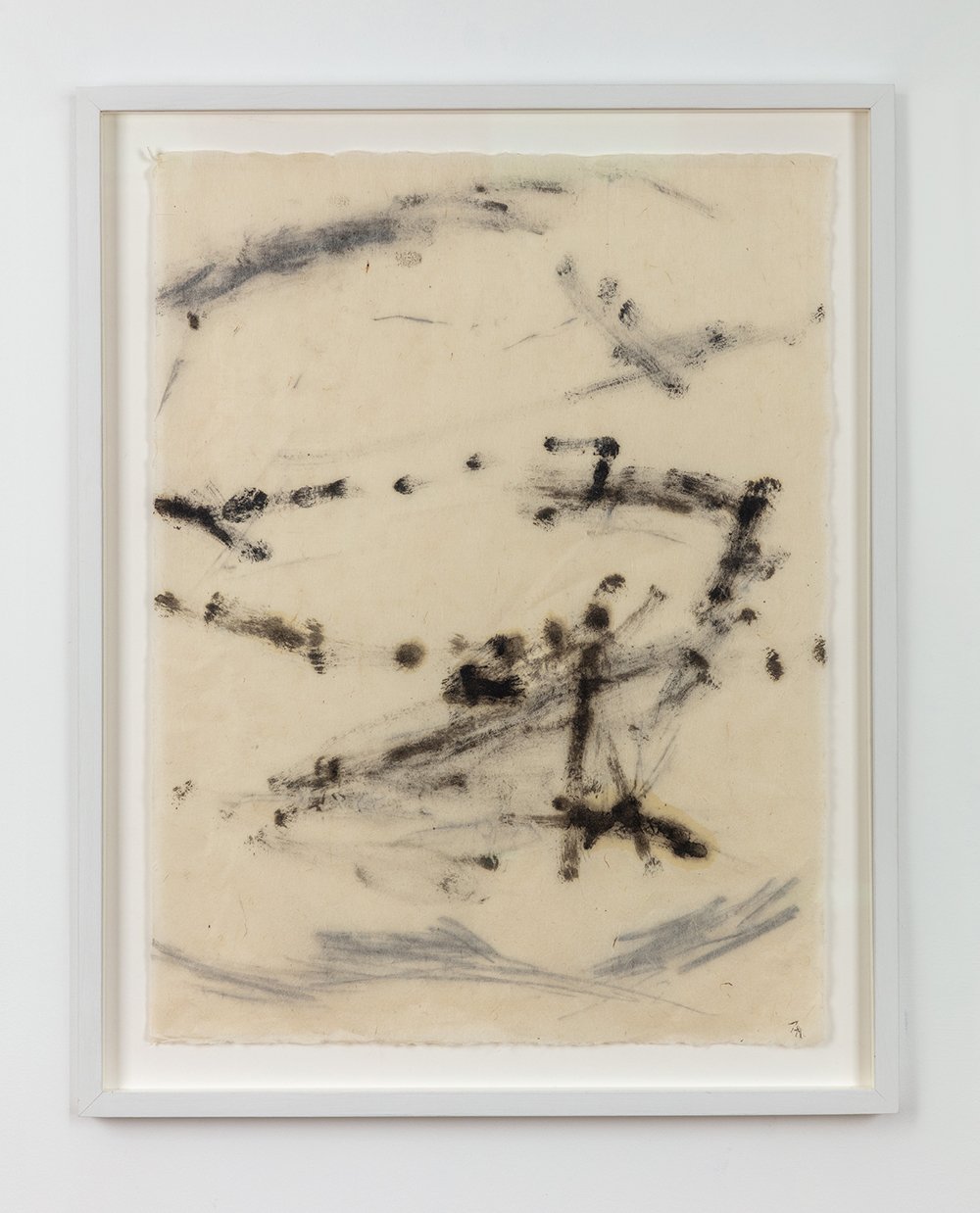
My disappearing drawings operate in a similar way. I would say my hit rate is about 10-15%. Something can look promising going into the kiln, but if it’s too light it can burn out or not change at all, which defeats the point. Ultimately, it becomes a question of how wrong is wrong. Some mistakes end up being your golden tickets.
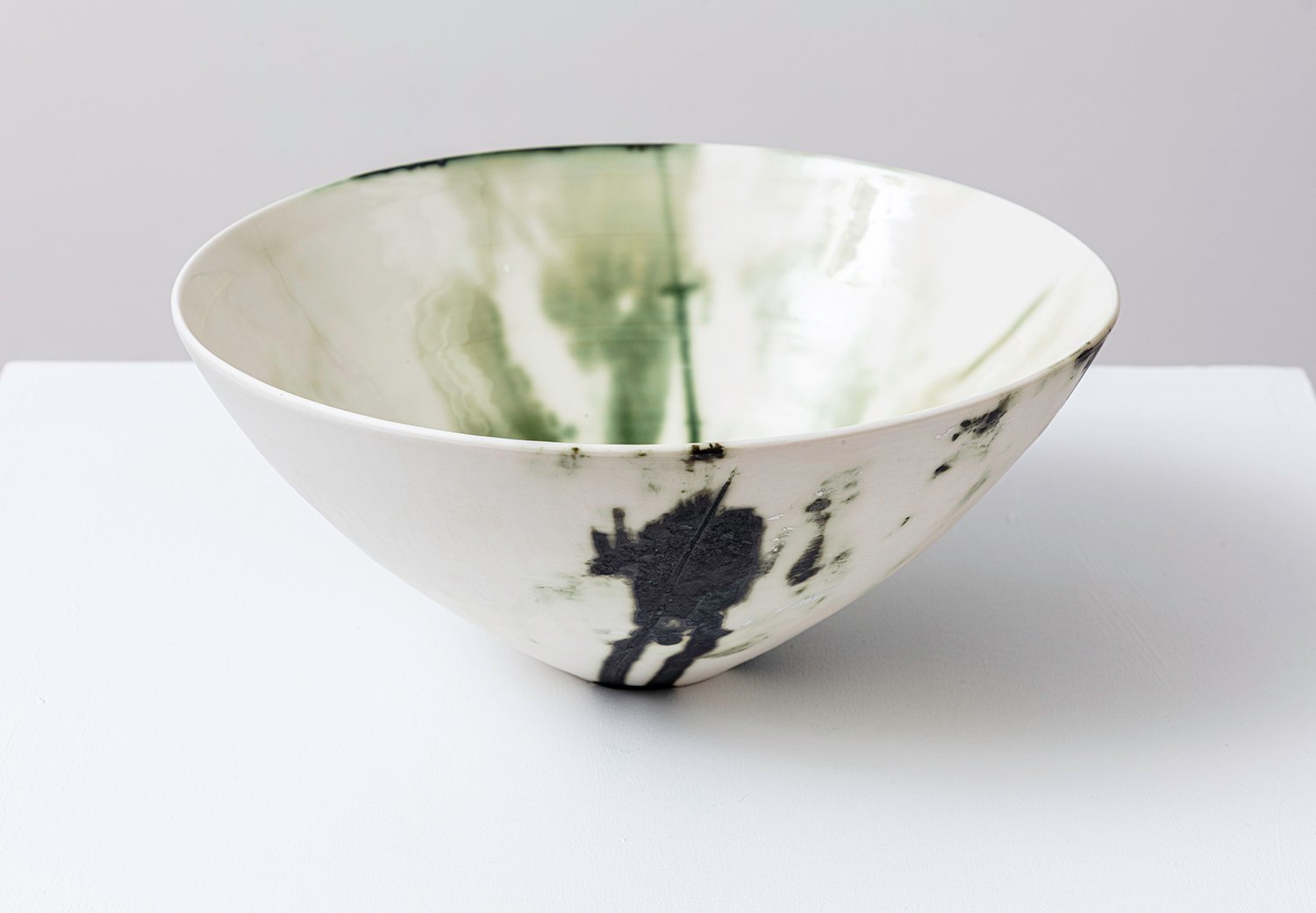
The Narcissus bowls were a beautiful disaster. I was building up layers of copper and a very fluid Nuka glaze over several days, anticipating movement in the kiln. I propped the pots on kiln brick to catch any runs, but as the glaze burned through the brick completely disintegrated and all the bowls began to fall over. Complete failure. That was all I could think in the very long hours waiting for the kiln to cool. But looking again, I realised I liked it. The tipping displaced the centre of the glaze and caused the bowls to ovalise. It brought them to life. I continued firing them on these unstable, collapsing props.
The pomegranate bowls came out of a similar accident. I had thrown them so thin that the copper applied to the exterior migrated through the body of the clay. That was a key moment. It shifted how I approached the form and the relationship between interior and exterior, not drawing on the surface but allowing the material to physically move through it.
Over time it becomes less about control and more about trust. I place that trust in the materials and in our kiln god, wrongly named Loki. Perhaps that is why I’m drawn to ancient Greek myths. Like Persephone’s return, I trust that things will work out if I keep going.
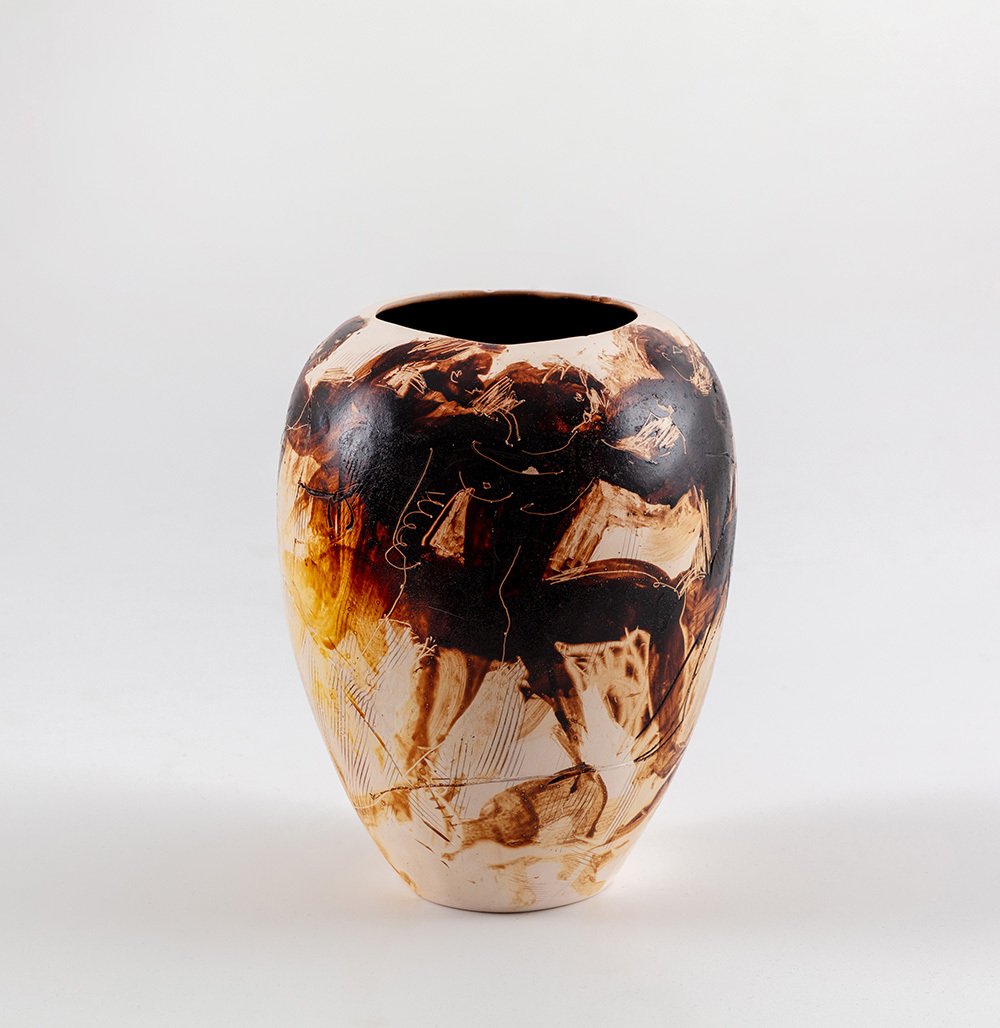
Notably, you destroyed your artwork from The Drawing Year and used the remains in this new work. Can you tell us about this method, which is so at odds with the way in which artists are often encouraged to archive and preserve their works for posterity?
Weirdly, this was the most liberating thing. The Drawing Year is an incredible incubation space, and you make more drawings than you can imagine. I started shredding them simply to make everything more manageable, and to take some of the emotion out of it. By burning them at different temperatures, I was able to access a range of pigments, charcoal and ash, which I could then use in both drawing and ceramic processes.
I fundamentally believe that when you are learning, you have to allow yourself to make bad work. It’s so symptomatic of everything in life to try and get things ‘perfect’, but it’s only when they aren’t that you begin to think critically and approach them differently.
Don’t get me wrong, when I love something I will take great care to preserve it. But until that point, everything stays open and active. I’m happy to let the work reincarnate and evolve, and sometimes the missing ingredient is simply time.
Your research spans collections at the British Museum and digital archives from the Metropolitan Museum of Art and National Archaeological Museum. How did engaging with these ancient objects inform the narratives within your ceramics?
I work strictly from observation, so I rely on these objects directly. There are so many Greek pots, but focusing on this hymn allowed me to isolate a small group of vessels that I kept returning to. I’ve been lucky to see some in person, like the kylix at the British Museum, but online you can get much closer. The digital collections are phenomenal. I love zooming in incredibly closely, which allows me to move between a micro and macro view.
I’ve been drawn to the formal language of ancient Greek pottery. Certain shapes had specific functions, often paired with consistent visual structures. The question became how to respond to that. With the kylix, the central circle called the ‘tondo’ became a point of focus. I pushed this in my falling Narcissus bowls, where the centre shifts as they tip. Across the works, strong diagonal compositions recur, but the fragmentary nature of my pieces allows me to approach this language in a contemporary way. The restored lines interrupt the underlying structure and introduce new rhythms.
How has The Christie’s Award supported your practice over the last year? And what does it mean to you to be exhibiting at Christie’s in Central London?
The Christie’s Award has honestly been an oxygen mask for my practice. During The Drawing Year, I was pulling at a thread of how ceramics might interact with drawing. This opportunity has given me the space and time to develop that work properly. The support network has been phenomenal and I’ve been fortunate to work with an incredible constellation of people, most notably my mentor Fraser Scarfe. It has also given me a clearer sense of what it means to build a solo exhibition and how to build a cohesive body of work.
For the first half of the year, I was still in a development phase. A turning point was seeing the Picasso exhibition at Christie’s, where the use of copper on unglazed white earthenware really stayed with me and set me on a clearer path.
I still have to pinch myself that this is happening. If you had told me two years ago that I would be exhibiting at Christie’s, I wouldn’t have believed you. It’s an incredible honour. The Drawing Year was full of incredibly strong artists, and I feel lucky to have been part of that group.
Continuing the theme of renewal, do you have thoughts about how your work might transform from here?
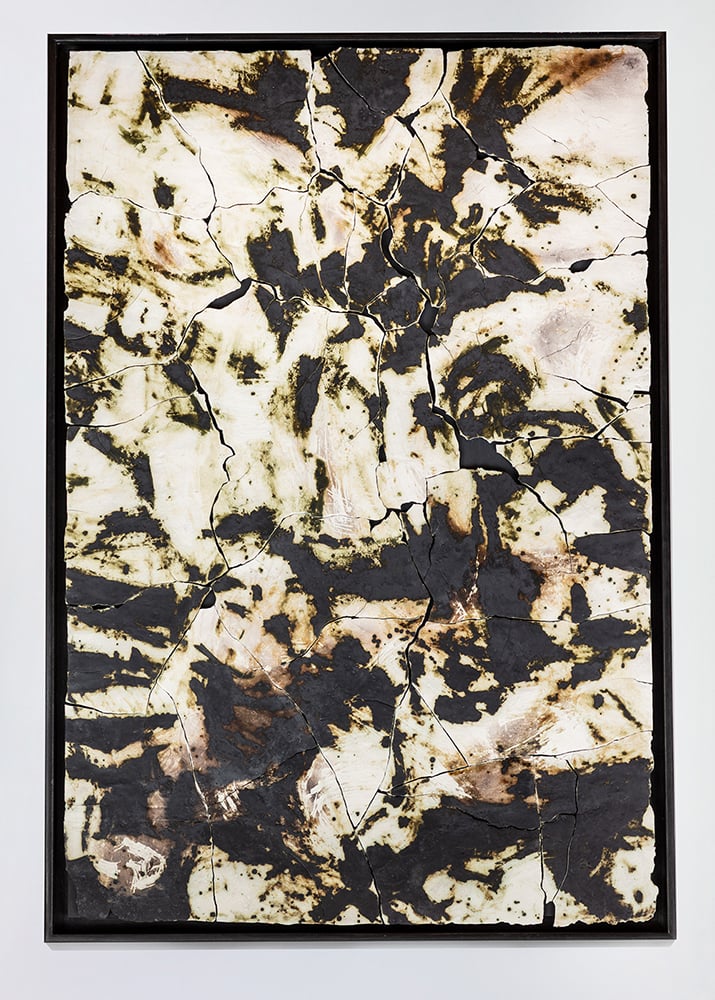
I feel like I’m just getting started. In the spirit of the Eleusinian Mysteries, with their movement of descent, search and ascent, I think much of the Christie’s Award has been about searching. A lot of that has centred on experimentation, especially in the tile arrangements and how to deal with the cracks. In the end, it became about letting them crack.
I’ve really valued developing a relationship with my framer, Martin West, to realise the potential of the float-mounted tile assemblies. That’s something I’m excited to keep pushing. Alongside that, I see more collage-based vessels growing out of what remains. They’re slow and labour-intensive, but there’s something very organic in that process.
When this is all over, I’m going to take myself on an artist date to the British Museum, buy a coffee and a cake, and just be there for a few hours drawing. One caught my eye the other week, the moment where Odysseus returns to his own home disguised as a beggar…
Lessons in Spring opens at Christie's on 13 April. This exhibition is kindly supported by Christie's.