
Drawing outdoors Drawing exercise
As a landscape painter, I often work directly outdoors, braving all weather. As the seasons change, drawing can be particularly useful for recording seasonal changes, like a visual diary.
Drawing outside can be challenging. Logistically, it is often difficult to manage taking lots of equipment outdoors, working at scale, and dealing with ever-changing light conditions. I often find it hard to filter all the visual information we are confronted with, and to decide where to start.
When recording seasonal changes, I find it best not to go outside with any intention of making a finished work or a fully formed ‘landscape’ in the traditional sense. Instead, I take a small sketchbook or sheets of paper and use them as a simple visual diary, moving around my garden or a landscape and recording only the things that interest me. That might be hanging branches, a patch of grass or sky, or even a group of weeds. I do not worry too much about composition. These notes and drawings often present themselves as options for larger works or paintings that I can complete when I have more time, or when I am back in the studio.
With that in mind, the exercise below is a simple way to work outdoors and gather a series of quick observations.
Where
Outdoors in a garden, park, or landscape of your choice. (You can also work from a garden/yard view if you need to stay close to home.)
Materials
- A small sketchbook or small sheets of paper
- A limited selection of drawing media (pencil/pen/charcoal etc.)
- Optional: a small range of colour (try to include both warm and cool tones)
- Something to sit on / a firm surface to draw on (optional but helpful)
- A subject to observe branches, weeds, grass, sky, foliage, anything that catches your attention
Steps
- Go light on equipment. Bring a sketchbook or a few small sheets of paper, and only a manageable selection of tools. The point is to make drawing outside feel doable, not complicated.
- Choose your location. Find a garden, park, or landscape you can move around in. Spring and early summer are especially rich for this, longer days, verdant colours, and blooming foliage can become a kind of visual diary.
- Limit your media choices. If you’re using colour, keep the palette restrained. Pick colours that match the time of day, light, or temperature, and consider having both warm and cool options.
- Draw as a visual diary, not a finished landscape. Avoid the pressure of composing a traditional landscape. Instead, make quick recordings of whatever interests you most: a hanging branch, a patch of grass, a slice of sky, a cluster of weeds.
- Shift your viewpoint. Before starting each new drawing, change how you look: try looking up, down, close-in, or from an unusual angle rather than straight ahead.
- Work fast and rotate subjects. Spend no more than 10 minutes on one drawing. In an hour, aim to collect several short responses rather than one ‘complete’ image.
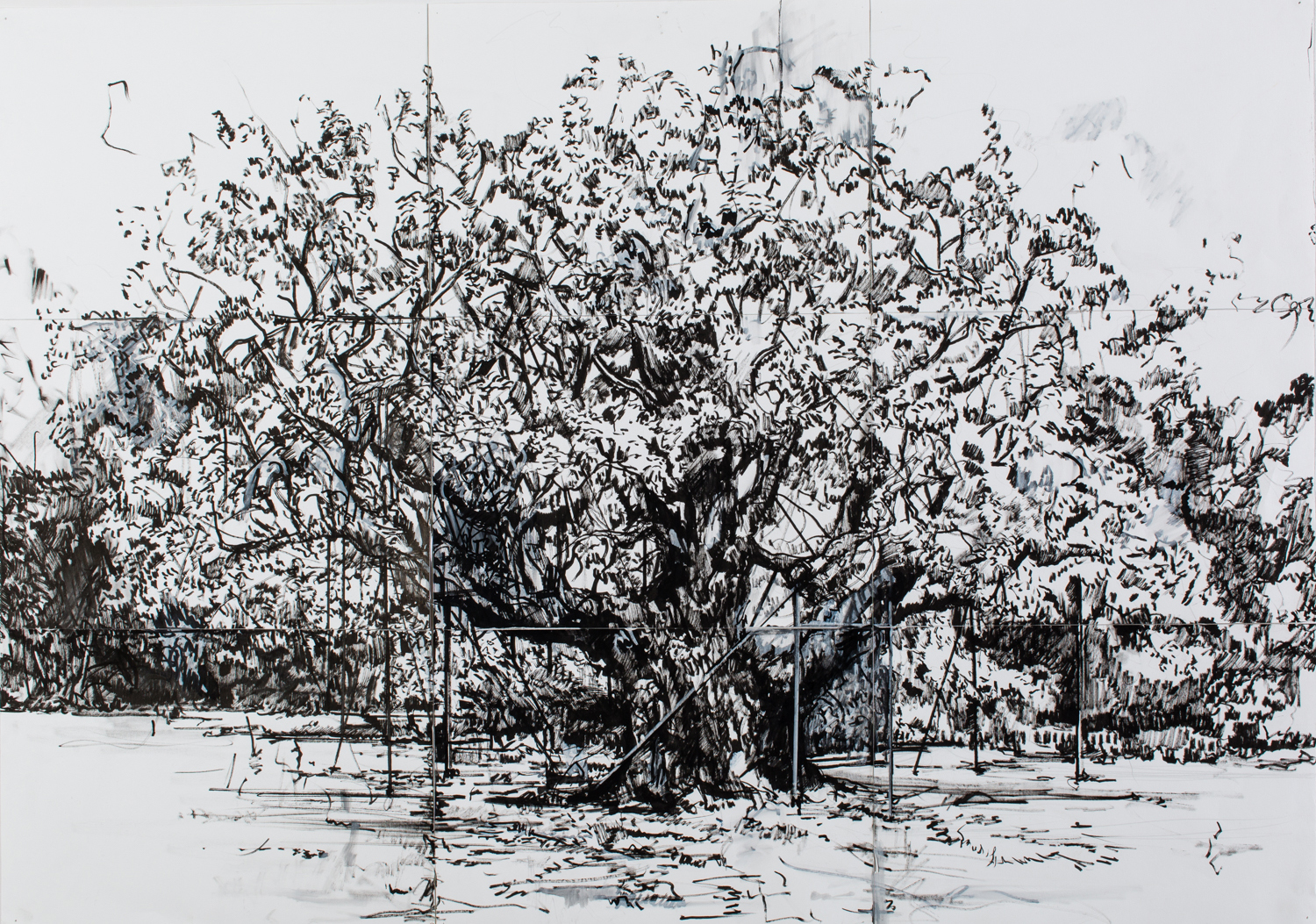
Featured artwork: Fraser Scarfe, 'The Major Oak', 2016, ink on Paper, 100 x 70 cm, 2016