
The remnants of drawing Frank Bowling

Tracing how the discipline of drawing continued to shape Frank Bowling’s work, from figuration to abstraction.
View all Living Library content
Frank Bowling_NORBERT LYNTON_963_acrylic on paper_50.2 x 34.2 cm_Courtesy the artist_Photographed by Anna Arca_Front
Frank Bowling 'Norbert Lynton', 1963, Acrylic on paper
“Drawing was very important,” Frank Bowling explained when we exhibited one of his early figurative works, Norbert Lynton (1963), at the Royal Drawing School. “At the Royal College of Art, the whole training was about life drawing, drawing for life… I still have the inclination or the remnants of that way of proceeding.”

This sense that drawing persists in his work, not as an early stage passed through but as something enduring, sits beneath Bowling’s six-decade long career. Today, he is best known for his large-scale abstract paintings that explore the material possibilities of paint, from the colour-soaked ‘map paintings’ to the later ‘poured paintings.’ These fields of colour and cascading swathes of paint seem to erase the figure and the drawn line. So where does drawing live in this work?

Bowling’s early practice was rooted in figuration. Born in Bartica, Guyana, in 1934, he moved to London in the 1950s, where he first encountered artists while working as an artist’s model. This experience brought him into close contacts with working artists in London and led to his decision to study at the Royal College of Art, where he joined a cohort that included David Hockney and R. B. Kitaj. At the College, life drawing and still life were central to the curriculum, and drawing from observation was a way of understanding the body, space, and composition.

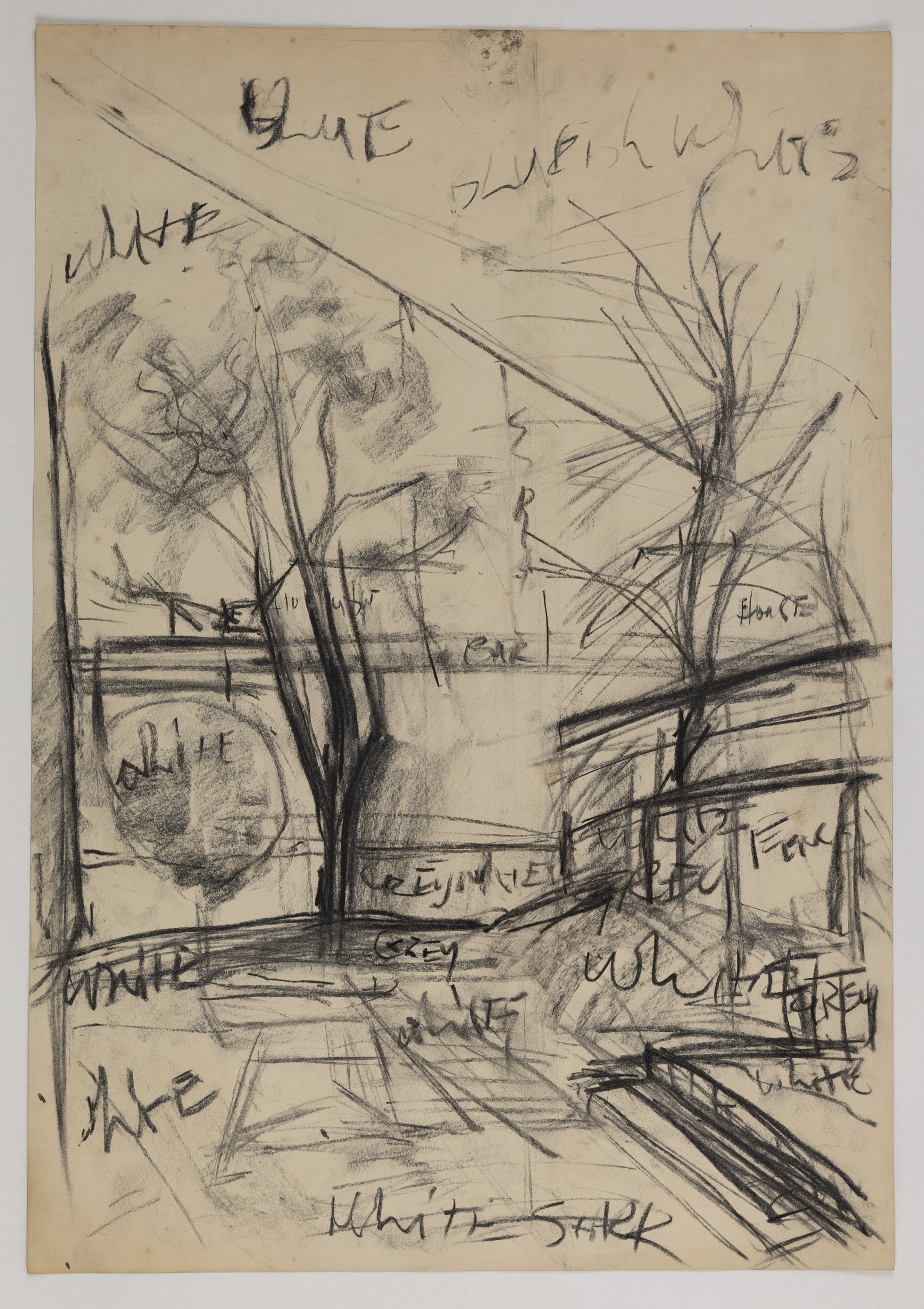
His early works show how drawing served as an integral part of his process. Sketches in his archive reveal how he used drawing to turn perception into structure. In a preparatory sketch for ‘Snow Painting’ during his monochromatic period, he maps the view from his house in Clapham. Names of colours (‘white,’ ‘grey’) and objects (‘bar,’ ‘house’) are nestled among loose charcoal marks. Drawing functions both as record and a way to work through form before translation to a larger scale: Bowling is thinking-through-drawing. In the large-scale work derived from this sketch, the act of drawing persists; thick applications of white paint climb the tree branches while darker grey lines still encase them, guiding composition and structure.

FB_12_1_4_15 Prep sketch for Snow Painting 1962 by Frank Bowling copy
Frank Bowling 'Preparatory sketch for Snow Painting', 1962, ©Frank Bowling Courtesy Frank Bowling Archive
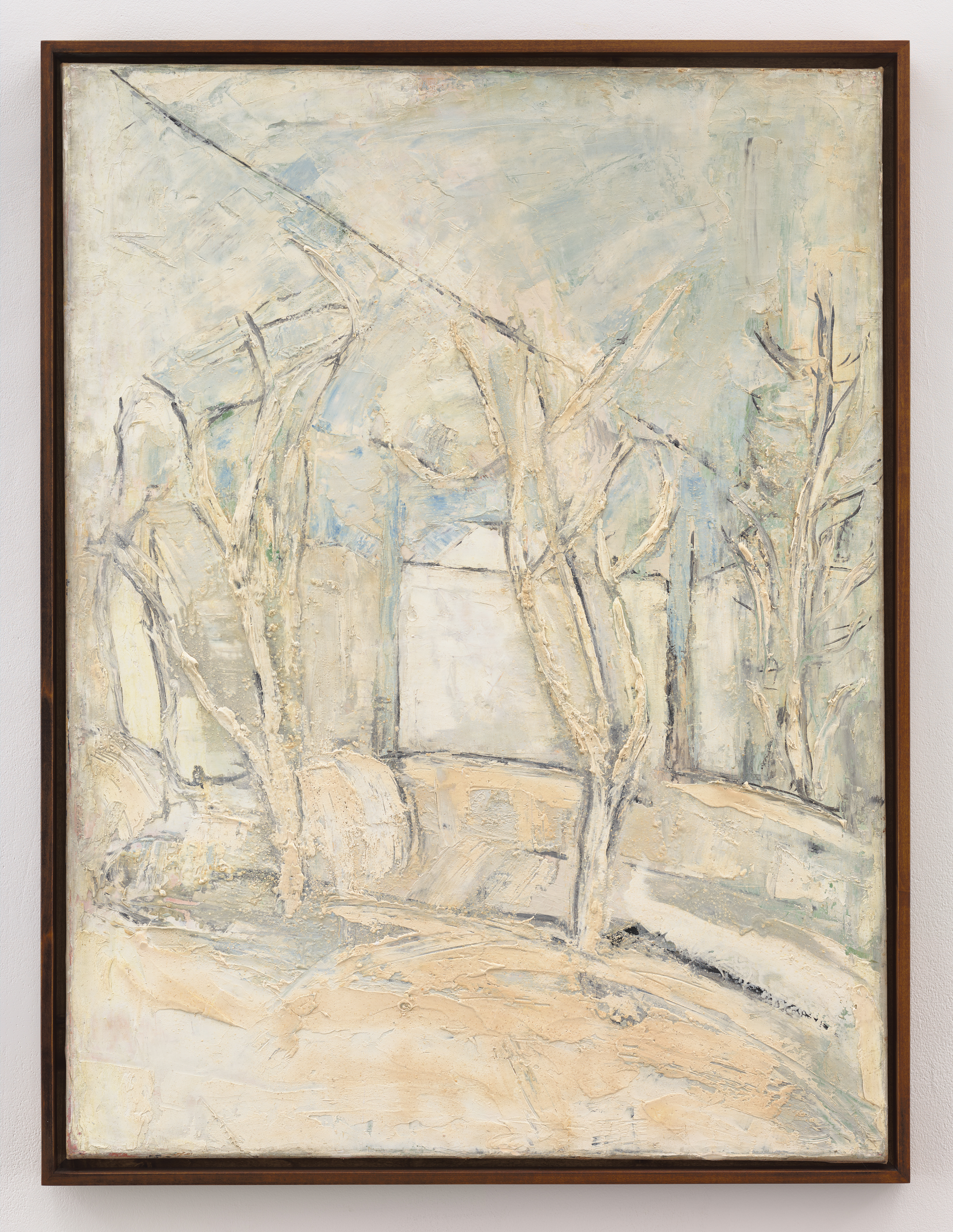
Snow Painting, 1962, oil on canvas, 102.1 x 75.8 x 1.5 cm. Courtesy the artist. Photographed by Anna Arca
Frank Bowling 'Snow Painting', 1962, Oil on canvas, 102.1 x 75.8 x 1.5 cm. © Frank Bowling. Courtesy of the artist
Barticaborn I, 1967, acrylic on canvas, 235.6 x 124.9 cm. Courtesy the artist. Photographed by Stan Narten
Frank Bowling Barticanorn, 1967, Acrylic paint, spray paint, and oil wax on canvas, 234 x 122.4 cm. © Frank Bowling. Courtesy of the artist

After his move to New York in 1966, the drawn line and figure began to disappear as he turned further toward abstraction. Immersed in the world of the Abstract Expressionism, Bowling was encouraged, by artists such as Larry Rivers, to move beyond figuration. His move to the US has often been read as a story of liberation: from the dogmatic English art-school discipline of life drawing to the open, gestural freedom of New York abstraction.

Yet even within this shift, the discipline of drawing persisted. His celebrated ‘map paintings’ (1966–1971) act as a bridge between the figurative and the abstract. Each map began with drawn outlines of continents, traced and cut from stencils before being flooded with poured colour. The map drawing provided both conceptual armature and compositional skeleton: a way of holding form within fluidity. The drawn edge survived even as it dissolved into paint. As Benjamin Bowling has described, his father was “freeing himself from the shackles of English art-school training,” but not from the habits of observation that training had instilled.

Bowling describes his abstract practice as “drawing with the materials themselves,” allowing paint, acrylic gel, chalk dust, and water to perform the functions once carried by pencil or charcoal. He speaks of “aiming all the time to get a perfect rectangle” within his colour-field paintings, using paint as a means of placement and balance. In this sense, the logic of drawing endures; composing and structuring, even when line gives way to liquid.

Across six decades of work, drawing in Bowling’s work is not confined to graphite or contour; perhaps it is a way of thinking, a discipline that survives even amongst all the free-flowing paint. In his words, “the remnants of that way of proceeding” endure not as yearning for figuration, but as an ongoing pursuit of order and clarity within abstraction.


Written by Lizzie Monaghan, Digital Education Senior Coordinator

Drawing was very important because the people that I admired, the working artists, the student artists and people working directly from life were very keen on having models and I modelled for them. I suddenly, during this time, got the urge. I’d been sitting for so many people; I got the urge to do it myself. I felt competitive too with those artists who drew all the time when I wasn’t doing drawing.

At the Royal College of Art, the whole training was about life drawing, drawing for life. It came out of that, it came out of me working out for myself how, not having been trained, how to draw, how I could teach myself to draw.

Today, I still have the inclination or the remnants of that way of proceeding. I still tend to draw my pictures with the materials themselves. I want the drawn lines to operate separately and by themselves, but they must fit into what they’re in: the flat, plain colour. I’m aiming all the time to get a perfect rectangle, and thus drawing, just drawing is the plan.”